The Baths, British Virgin Islands: Complete Visitor Guide

It’s easy to see why Virgin Gorda was just named the #3 island in the Caribbean by Travel + Leisure’s 2026 World’s Best Awards, with The Baths singled out by readers as a must-see. I first saw these giant granite boulders back in 2002 on a scuba diving trip; and after 6 years running sailing charters throughout the British Virgin Islands, they’re still one of my favorite spots to share with guests. If you’re planning your BVI itinerary, here’s everything you need to know about The Baths.
Quick Facts
How to Get to The Baths in the British Virgin Islands
There are a few different ways to reach the Baths, depending on where you’re staying and how you like to travel.
Public Ferry
Public ferries run from Road Town and Beef Island, Tortola to Spanish Town, Virgin Gorda daily.
If you’re staying in the US Virgin Islands, public ferries run from Charlotte Amalie and Red Hook, St. Thomas to Spanish Town, Virgin Gorda periodically. Some of these ferries have a few stops along the way, and you’ll be required to clear Customs & Immigration on this route.
🏖️ If you’re based on Tortola and want to make the most of your time there too, see our guide to the 20 Best Things to Do in Tortola 👈
From Spanish Town, you’ll catch a 10-15 minute taxi ride to The Baths.
Free parking is available at The Baths National Park for your car rental if needed.
Via Land (Taxi or Private Car)
A taxi from Spanish Town runs about $5-7 per person one-way. While a taxi from the northside of Virgin Gorda (Leverick Bay Marina), is about $10-15 per person one-way.
Power Boat Day Trip
Countless operators run day trips from St. Thomas, St. John, and Tortola to visit The Baths, along with other destinations.
👉 Click here to check out this awesome Day Trip operator! 🚤
Private Boat or Charter Yacht
If you’re coming in on your own vessel or a charter yacht, you have two options:
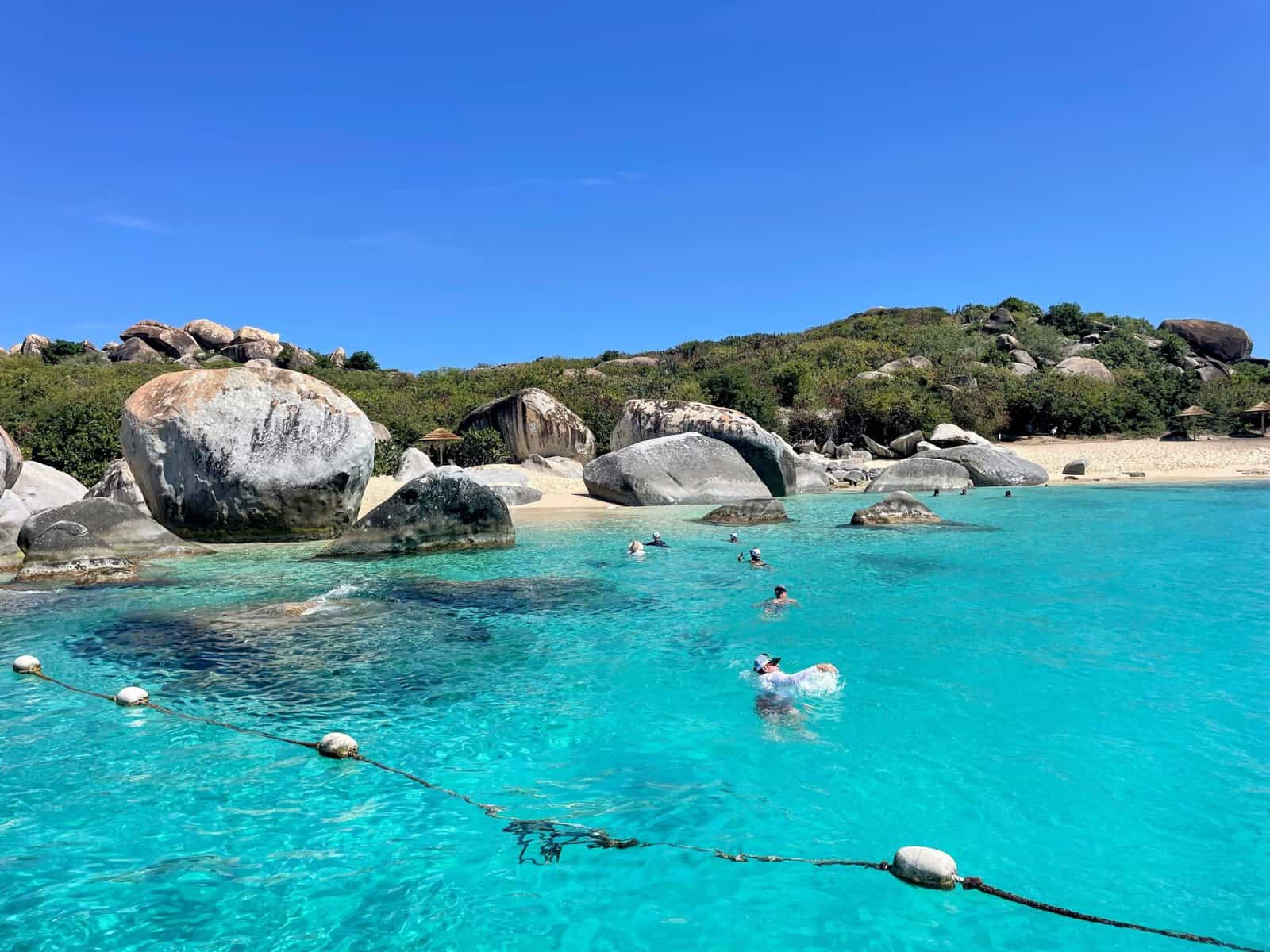
Enter by Sea – Swim in from the mooring field. The swim distance is about 150-feet from the dinghy mooring line. Know your limits, as this swim has caught visitors off-guard and resulted in incidents.
Enter by Land – Taxi from Virgin Gorda Yacht Harbor (in Spanish Town) or Leverick Bay Marina.

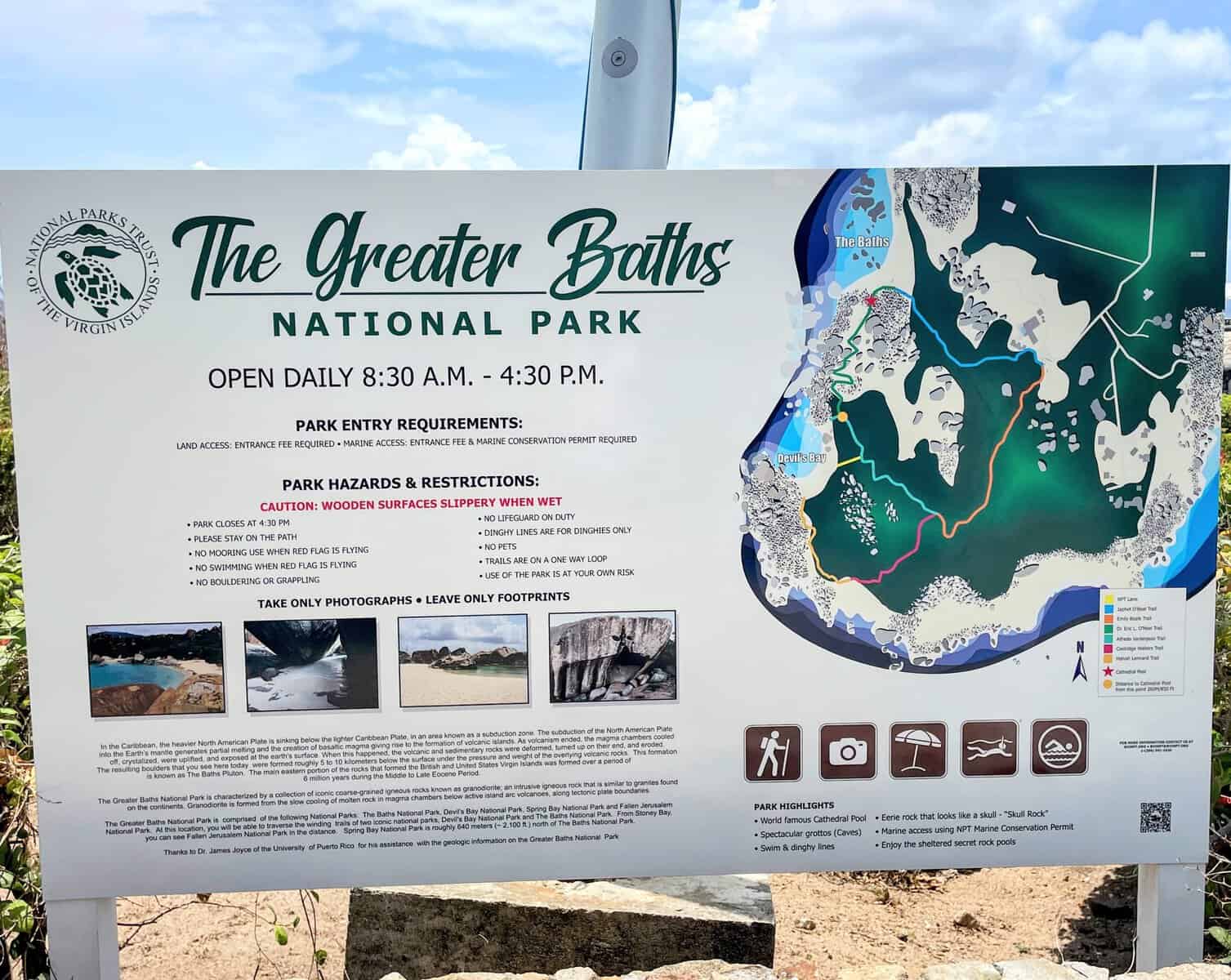
The National Parks Trust of the British Virgin Islands maintains a flag system to let boaters know the status of the mooring field and sea state. You will see yellow, red, and/or purple flags flying at the top of the hill above The Baths, another flying at Devil’s Bay, and another at The Baths beach. Staff keeps the flag colors updated throughout the day.
🟡 Yellow: the mooring field is open and you should exercise normal caution using the mooring balls and swimming.
🔴 Red: the mooring field is closed and access from the water is unsafe. Never moor or enter from the sea when a red flag is flying. The park is still open via land access.
🟣 Purple: a marine life warning is in effect, usually jellyfish. It’s advisable to wear a snorkel mask when swimming with a jellyfish warning. Moon jellyfish and comb jellies are most common in the Virgin Islands and do not sting. Seawasps can occur which have long tentacles that do sting, but they can easily be seen with a snorkel mask to avoid.
While anchoring in the National Park’s mooring field is strictly prohibited, you can anchor just north of mooring field at Valley Trunk then dinghy to the arrival area and swim in from the mooring field’s dinghy line. You cannot take the dinghy all the way to the beach; it is a no vessel area.
Entry Fee & National Park Info
Entry to The Baths is $3 per person. The entire area holds two National Park designations and share an entrance. Devil’s Bay was initiated as a National Park in 1964, and the cave system was designated The Baths National Park in 1990.
For those arriving by private boat, you can obtain a National Park’s mooring permit from any HM Customs or National Parks Trust office. The mooring balls can be used when a yellow flag is flying and have a 2-hour limit. It is prohibited to spend the night on any National Park mooring ball.
👉Click Here to Learn More about Chartering a Sailboat in the Caribbean👈
Best Time to Visit
The best time to visit The Baths is whenever there’s no cruise ship in port. If you’re visiting by cruise ship yourself, that will naturally limit your options, but if you have flexibility, it’s easy to check cruise ship schedules here to plan around them. The timing, size, and location of the ship in port can all make a difference in how crowded things feel.
The other prime window is when the sun is high in the sky, between 10:30am and 3pm. The lighting midday is when that bright Caribbean Sea really shines!
Early mornings are another sweet spot for those looking for fewer footprints in the sand.
Weather worth knowing:
If an ocean north swell is running, you’ll most likely see a red flag, meaning water entry is closed. The park is still open to visitors via land access. It’s a really unique experience to be there when the swell is running. You’ll hear the pounding and thunder of the waves coming through the caves. But it does mean exercising more caution climbing through the cave system by land, since the swell pushes waves splashing into the beaches and makes the water rougher.
Winter months bring higher winds and stronger currents which in turn are not ideal conditions for spending the day lounging in the ocean.
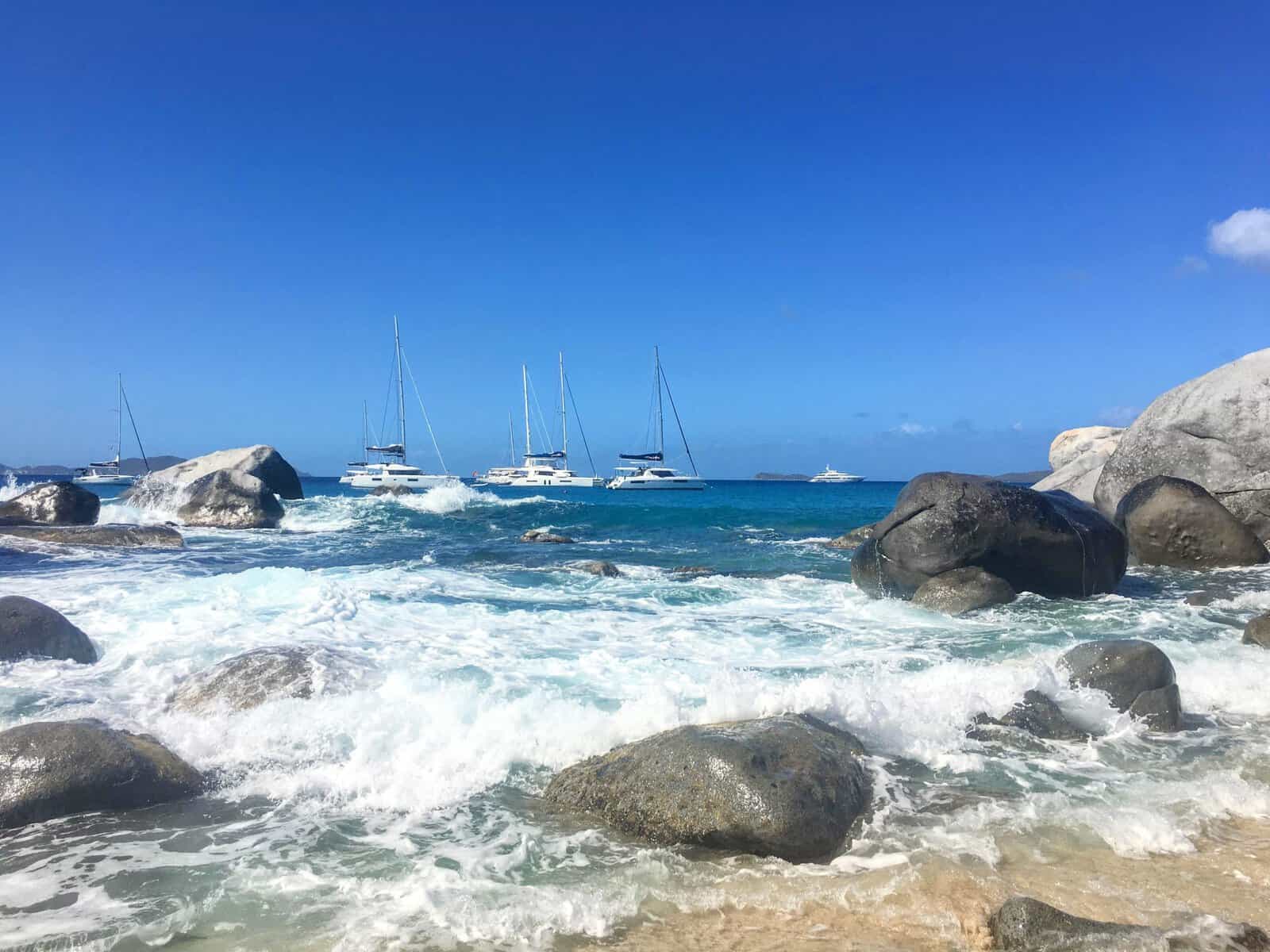
Late spring and summer months can bring calmer seas to the British Virgin Islands.
Late summer and fall is considered the rainy season meaning there is always a potential for hurricanes. It also means almost zero crowds.
What to Wear & Bring
The biggest thing to know about the Baths is that you will be swimming, so whatever you bring needs to be able to get wet. A dry bag is a smart idea for anything you want to keep out of the water. There are lockers available as well.
👉 Find our Essential Packing list for a sailing vacation by Clicking Here👈
For footwear, you want something you can easily walk in and out of the water with. Going barefoot works well through this section, and water shoes are a good option too. Flip-flops are not recommended in the caves, since you’ll be climbing over rocks and need something with support and grip.
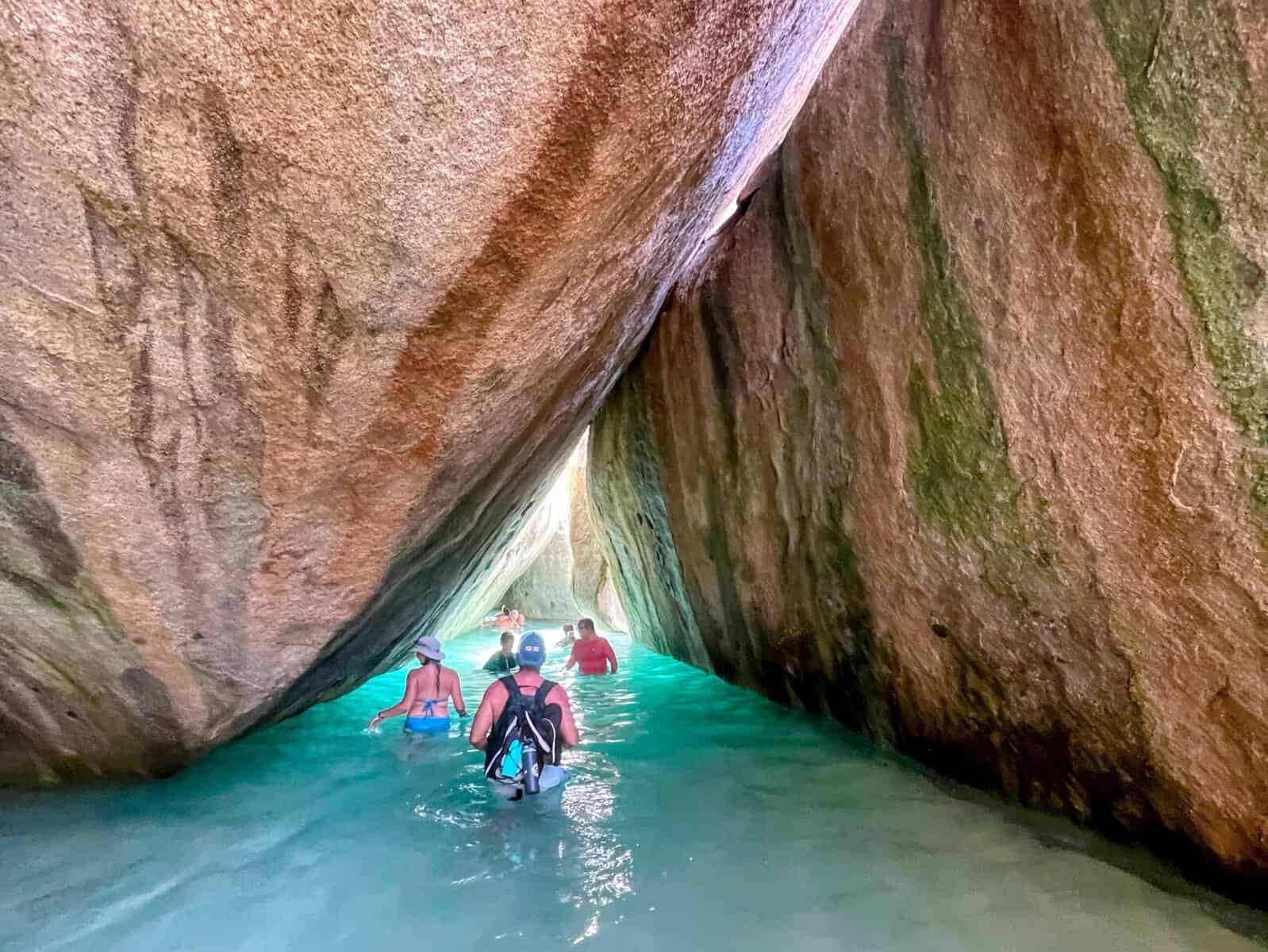
You’ll be in your bathing suit basically the whole way through The Baths.
Safety Tip: Remove or turn your hat backwards. There are low hanging rocks throughout the cave section, and we’ve had more than a few guests come back with bumps and bruises on their heads from forgetting this one.
The Trail
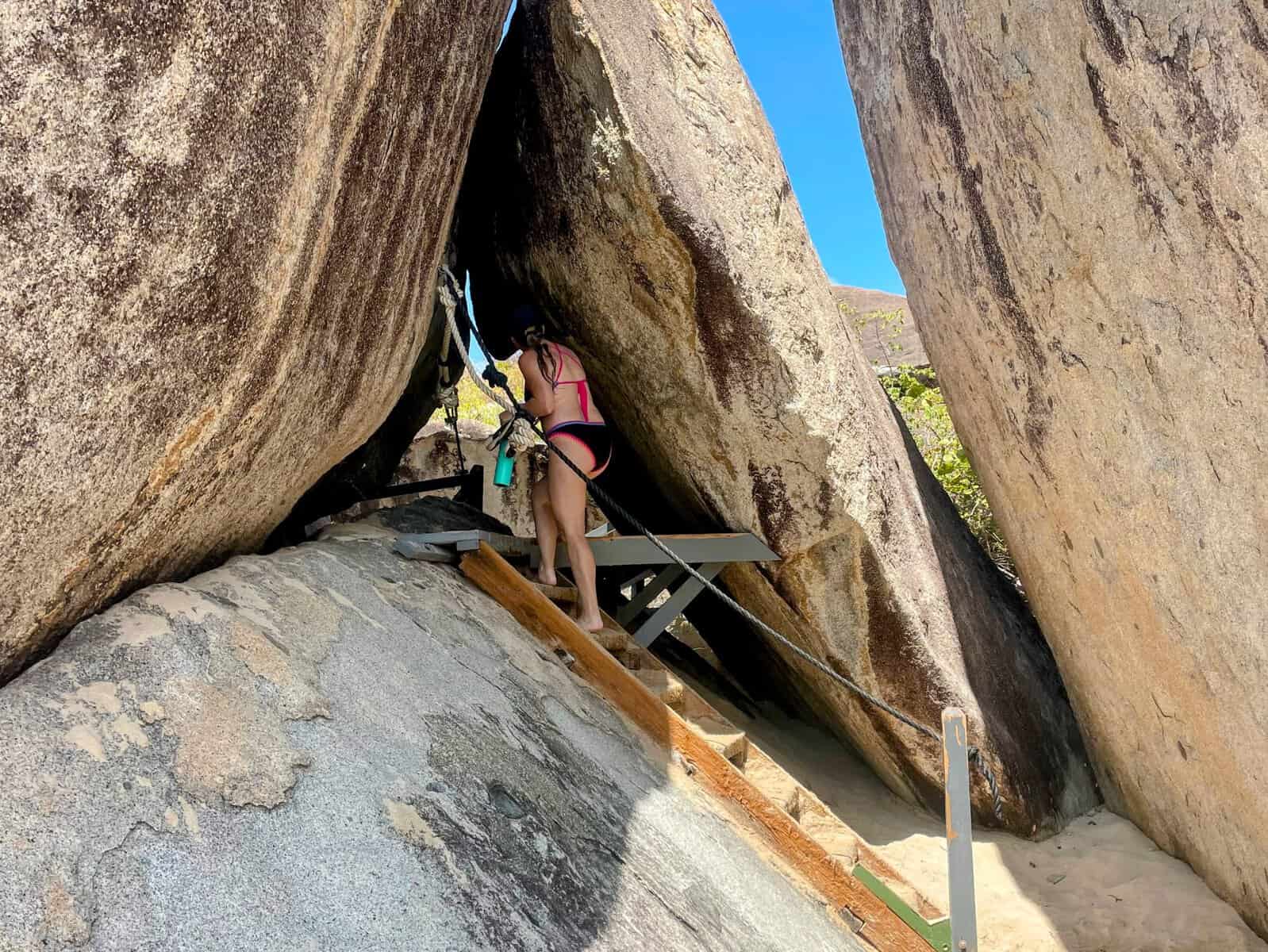
The trail system typically runs one way, especially when cruise ships are in port. If you’re entering from the top of The Baths (land entry), you’ll start on a downhill path that’s exposed and sunny, so bring plenty of water. It’s a short walk, about 10 to 15 minutes, over a dirt path with some rocks and wooden steps along the way with a couple of lookout spots with benches.
As you trek through the low-lying brush, you’ll likely see lots of lizards, and possibly iguanas, crabs, and hummingbirds.
You’ll come to a fork with a seating area and panoramic view of Devil’s Bay. Going left takes you to Stoney Bay, which is a rocky bay on the south side of Virgin Gorda rather than an actual beach. Stay right to continue toward The Baths.
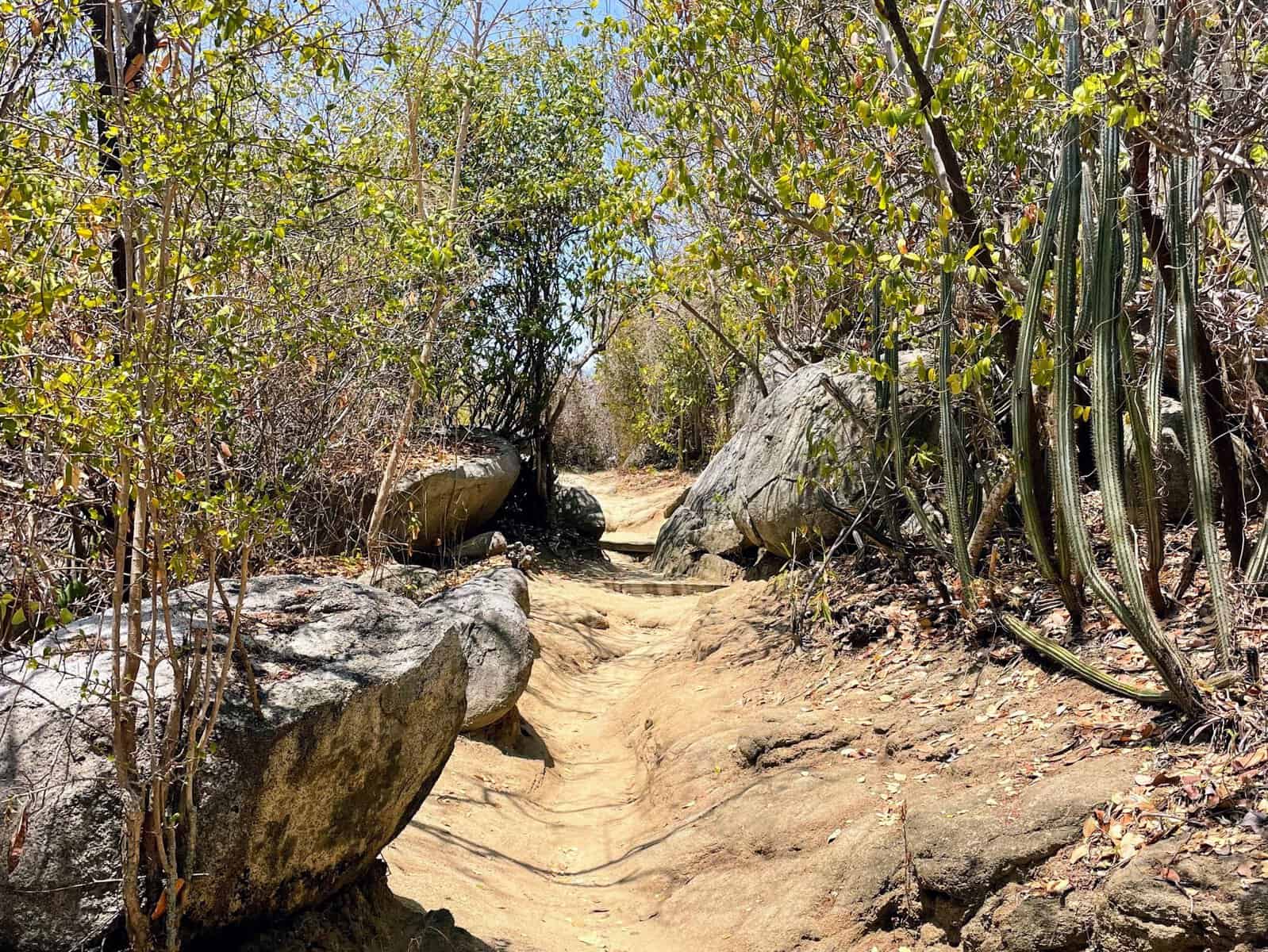
That brings you to a second fork. Left leads to Devil’s Bay, right leads to the caves. If you want beach time, head left to Devil’s Bay first, a beautiful strip of white sand with crystal clear water you can see straight to the bottom of.
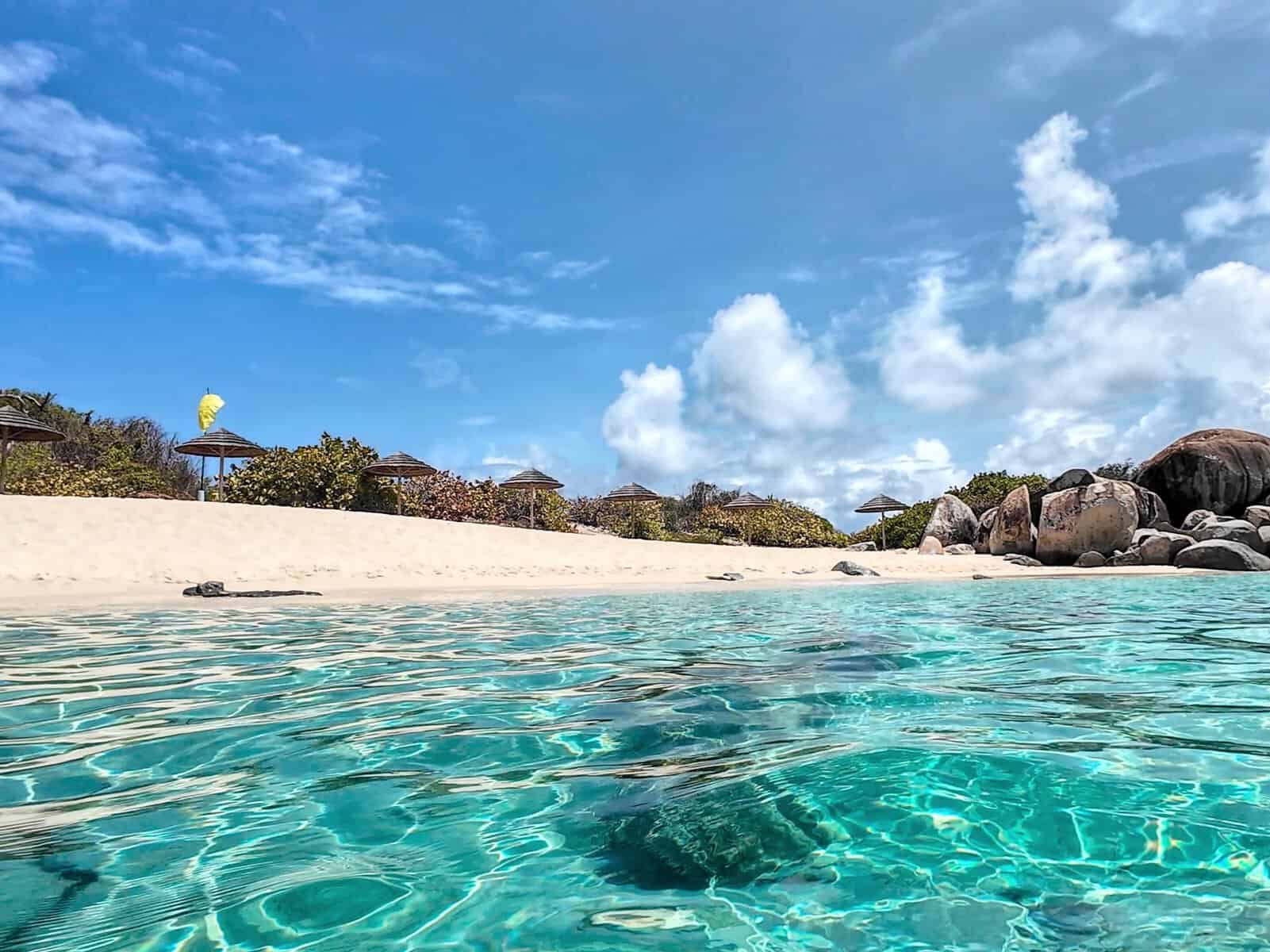
There are a couple of thatched roof tiki structures at the edge of the sand for a bit of shade, though they don’t offer much sun coverage in the afternoon. This is also where the first swim-in line is for anyone arriving by water.
The Caves
From Devil’s Bay, you can either hang out on the beach or swim over and enter The Baths between the boulders. At low tide, you can walk straight through the boulders from the beach into the cave system. At high tide, you’ll need to either swim in or head back up to the fork and take the path with the natural staircase down into the caves.
👉 Click here to discover even more of the best beaches across the British Virgin Islands 🏝️
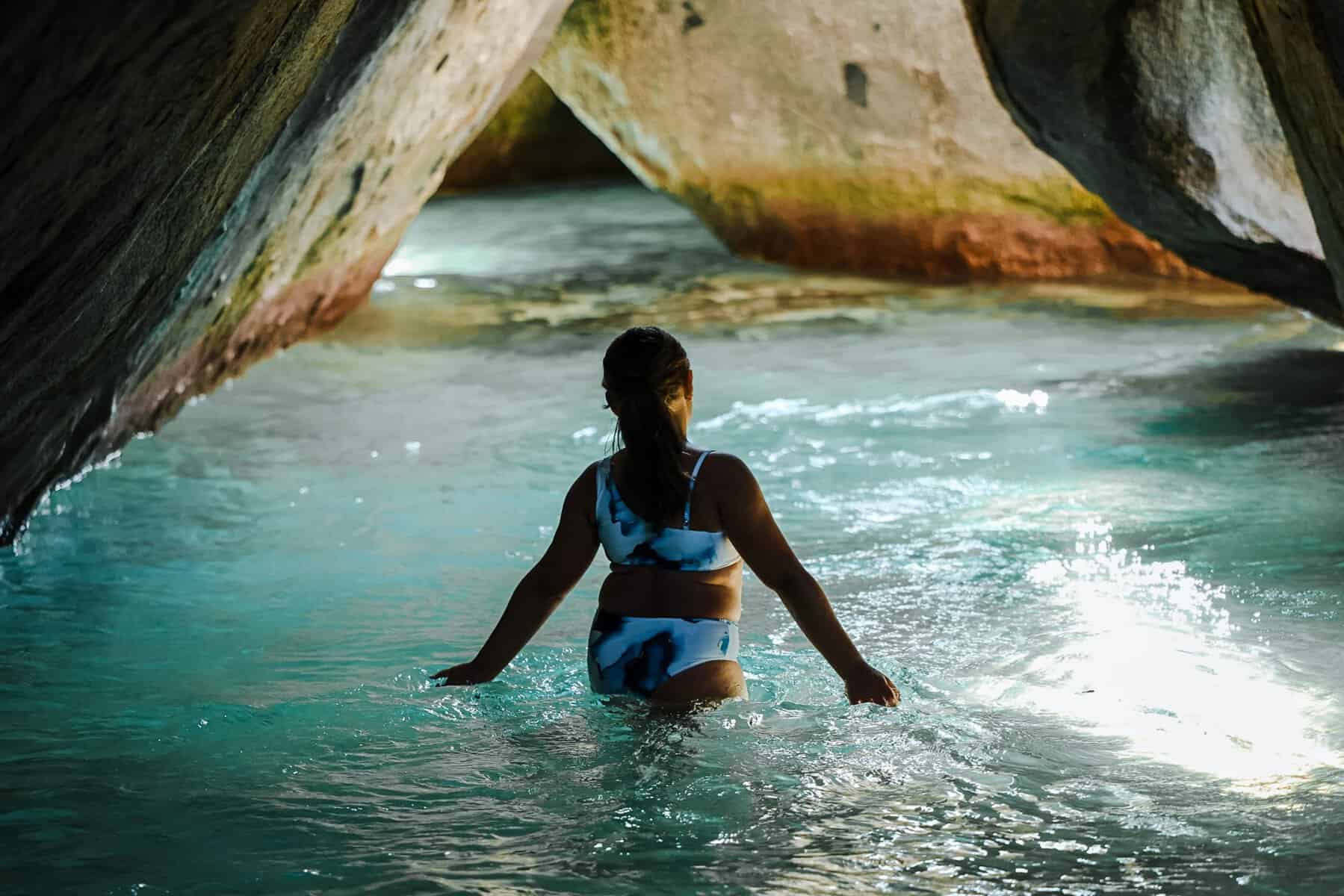
Once in the shade of the boulders, the temperature drops and the lighting effects tease you with photo ops at every turn. You’ll swim through some sections, climb over boulders, and find all kinds of nooks and crannies around the rocks. Don’t be afraid to get off the main path and swim back to see how far it goes.
There are ladders, ropes, and low hanging boulders throughout, so mind your steps, your knees and ankles, your kids, and anyone less steady on their feet. You do need to be mobile and comfortable with climbing, bending, and twisting through tight spaces, stairs, sand, and rock to go through the caves. The tight spaces are not terribly snug, and there’s always plenty of light shining through.
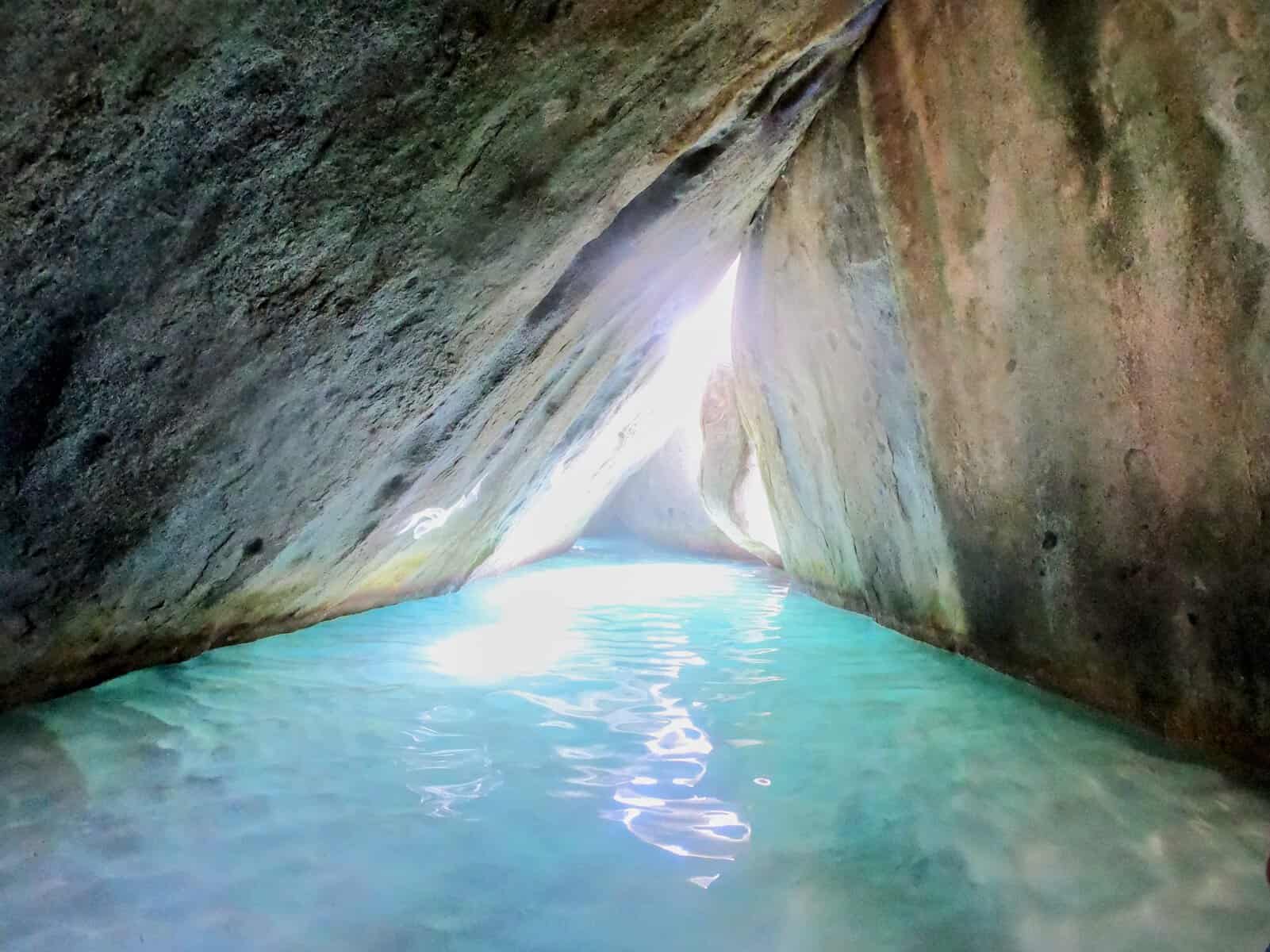
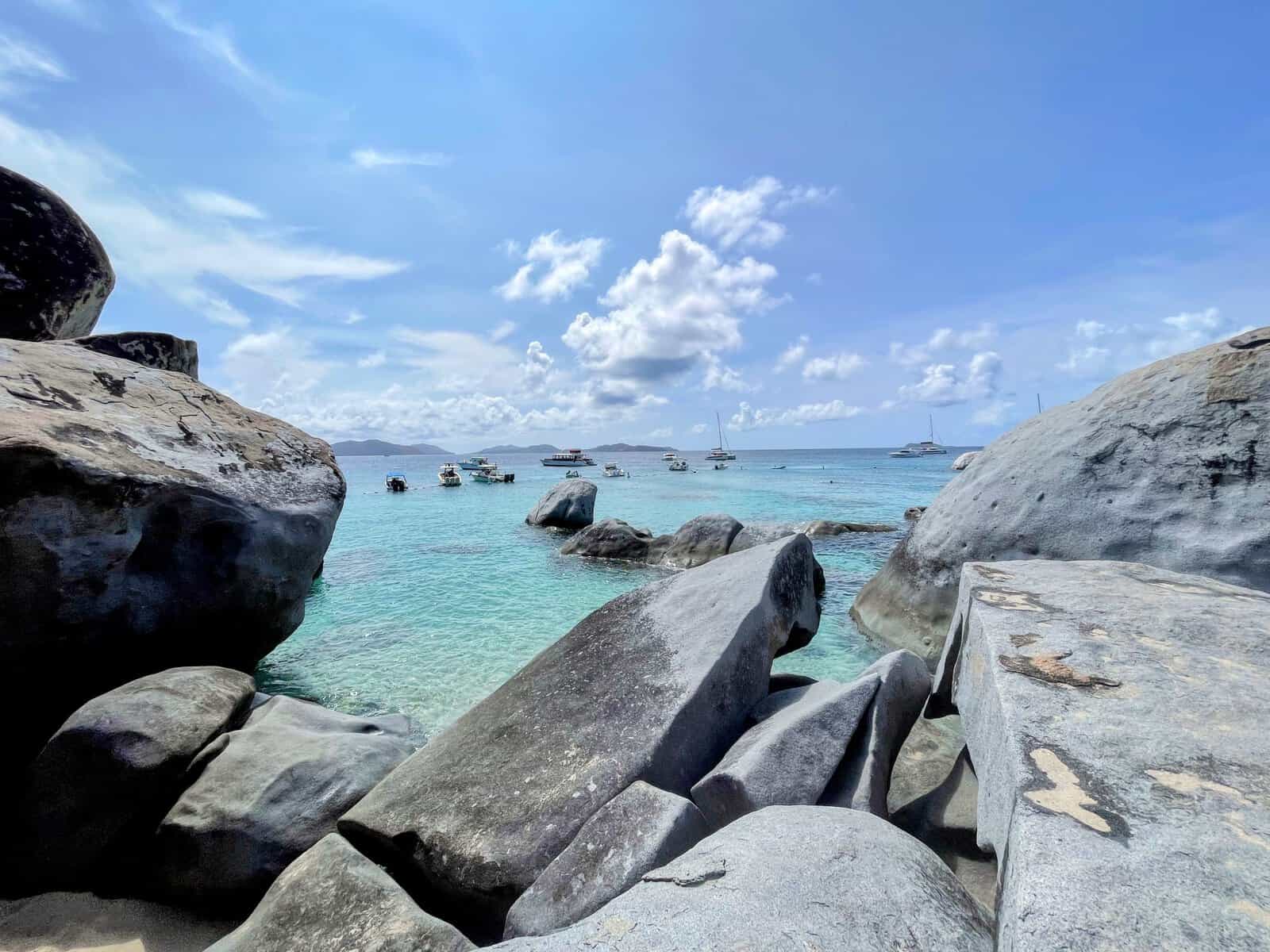
The Cathedral Room is the most well known part of the caves, and it sits at the very end of the circular route. The room opens overhead into a triangular gap between the boulders, where sunlight cuts down in narrow beams and lands on the water below. The effect shifts throughout the day as the sun moves, so no two visits look quite the same.
Most people take their photos in the Cathedral then head out. But here’s the Real Tip: after you get your photos, keep swimming to the back of the room. There’s a rock you’ll likely hit with your knee before you see it, then you’ll go over it on your belly, and it opens up into another hidden room. It’s a great spot for more photos and exploring. Depending on the tide, the water level changes from waist-deep to shoulder-deep for us shorties.
From the Cathedral Room, there are two ways out, one narrow and one wider around a rock. That drops you out at the other beach area, with more boulders to swim around and Poor Man’s Bar to purchase refreshments.
Snorkeling at The Baths
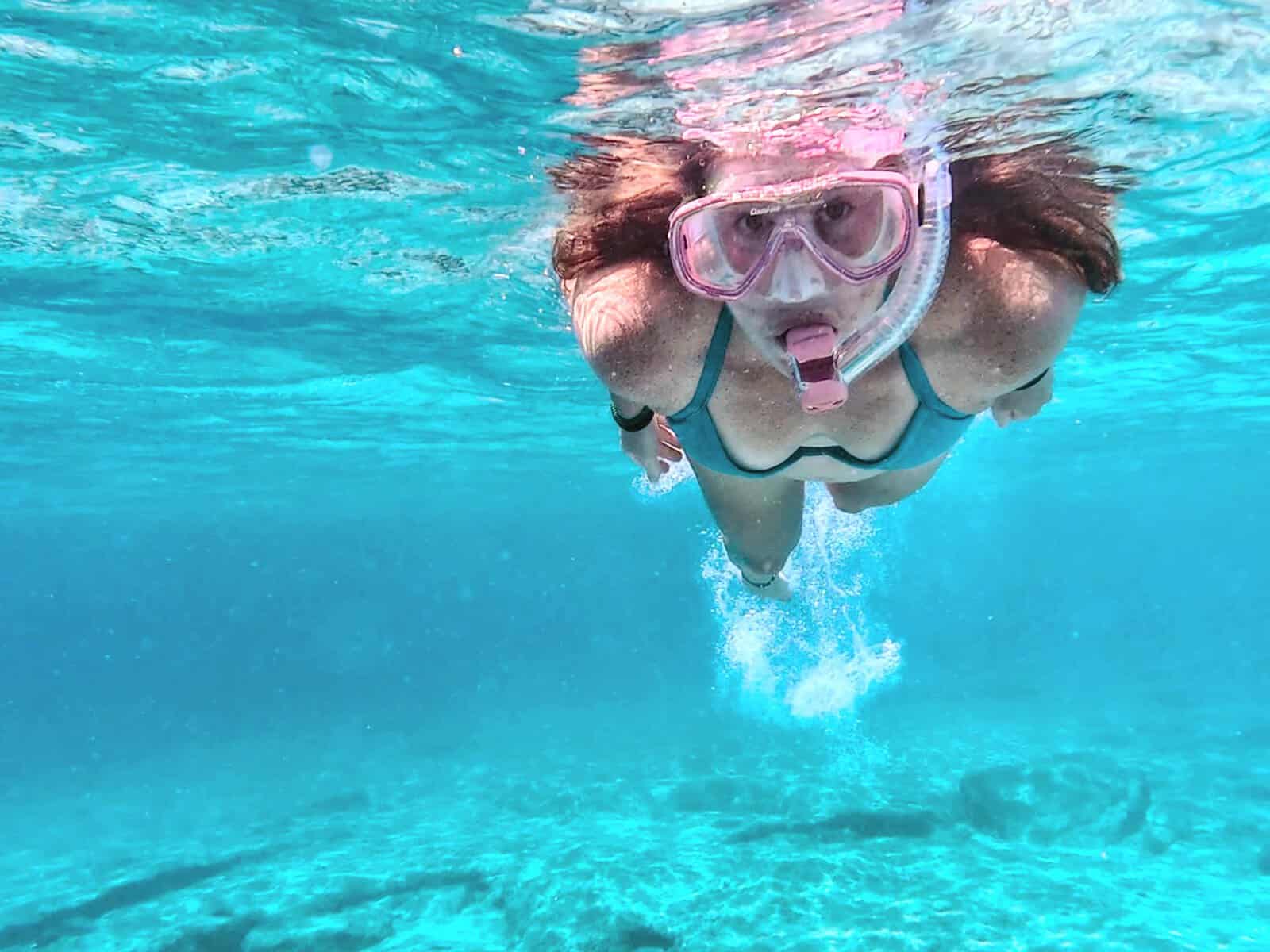
Whether you bring a mask really comes down to how much you want to carry. Fins aren’t necessary here. There’s not much of a vibrant reef right at the Baths, but you will see plenty of colorful fish, and below the surface, the water provides natural magnification of those really cool boulders, especially the unique surface features.
If you swim out and around the caves, especially if you’re entering from the mooring field, you can find coral further out in stunningly clear water. You might get lucky and spot rays or turtles on the white sand bottom.
The Geology of The Baths
The Baths have a fascinating geological history. Millions of years ago, molten magma seeped into layers of existing volcanic rock but never reached the surface. Instead, it cooled slowly underground, forming a massive body of crystalline granite known as a batholith (where this iconic site gets its name). As the granite cooled, it contracted and fractured into enormous blocks.
Over time, the softer volcanic rock above eroded away, exposing the granite. Wind, rain, and the sea gradually weathered the blocks into the smooth, rounded boulders that make The Baths so iconic today. You’ll find similar granite formations at Fallen Jerusalem and Broken Jerusalem just south of Virgin Gorda.
Devil’s Bay
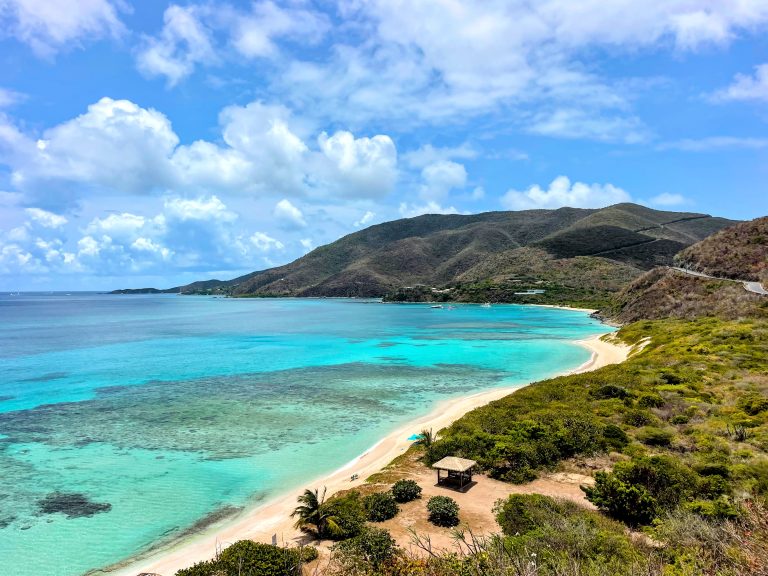
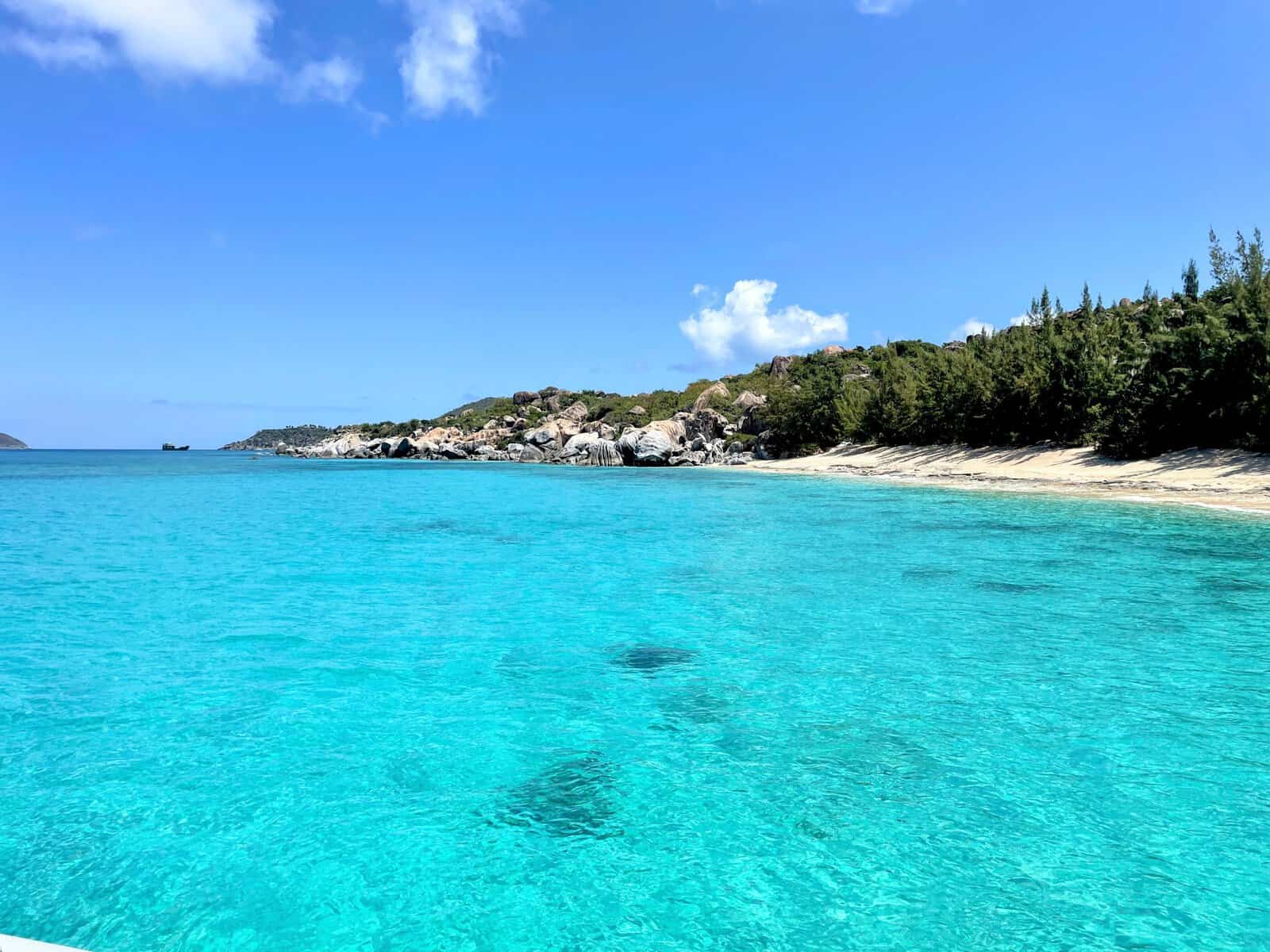
Devil’s Bay is less crowded than the smaller beach by Poor Man’s Bar and connects directly to the cave system, serving as the first access point if you’re coming from the trail or mooring field. The sand here is a picture-perfect white stretch of beach, and the water is so clear, you see the little fish swimming around your feet. There are no facilities on this side so plan accordingly.
Facilities: Restrooms, Lockers, Restaurants
At the top of the Baths, you’ll find a larger restaurant with a swimming pool, larger menu, and plenty of space to sit down and spend some time (aptly named Top of The Baths). If you’re making a full day of your visit, which we’d highly recommend if your schedule allows, this is a great spot to start or end the day.
Down at the bottom of the hill is Poor Man’s Bar, where you’ll find trinkets, souvenirs, and local artisans selling their goods, along with food and drinks. Just know it’s cash only.
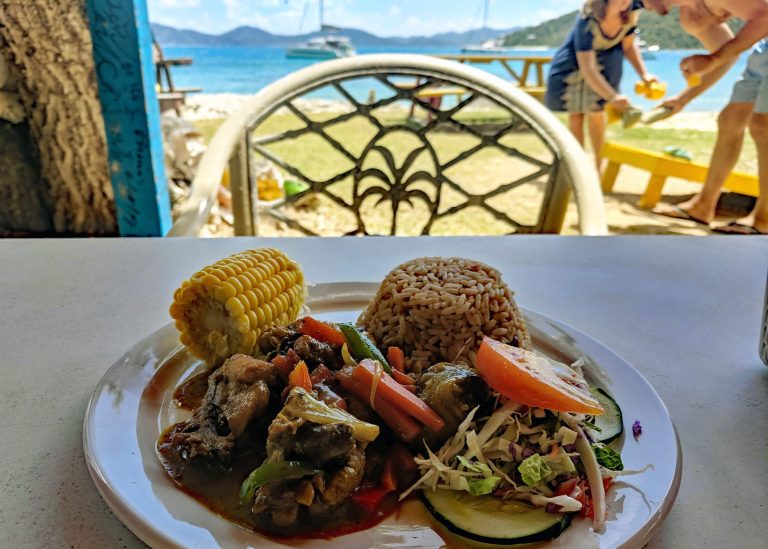
Located just outside of The Baths is Mad Dog Cafe. Serving up delicious local cuisine and ice-cold drinks, it’s an authentic experience by the top-tourist attraction!
Nearby Spots for Explorers
Fallen Jerusalem shares the same geologic features as The Baths, just south of Virgin Gorda. If you’re visiting by boat and the weather allows, it’s a great spot to snorkel, swim, and climb around the same kind of rock formations on a much smaller scale, usually with nobody else around.
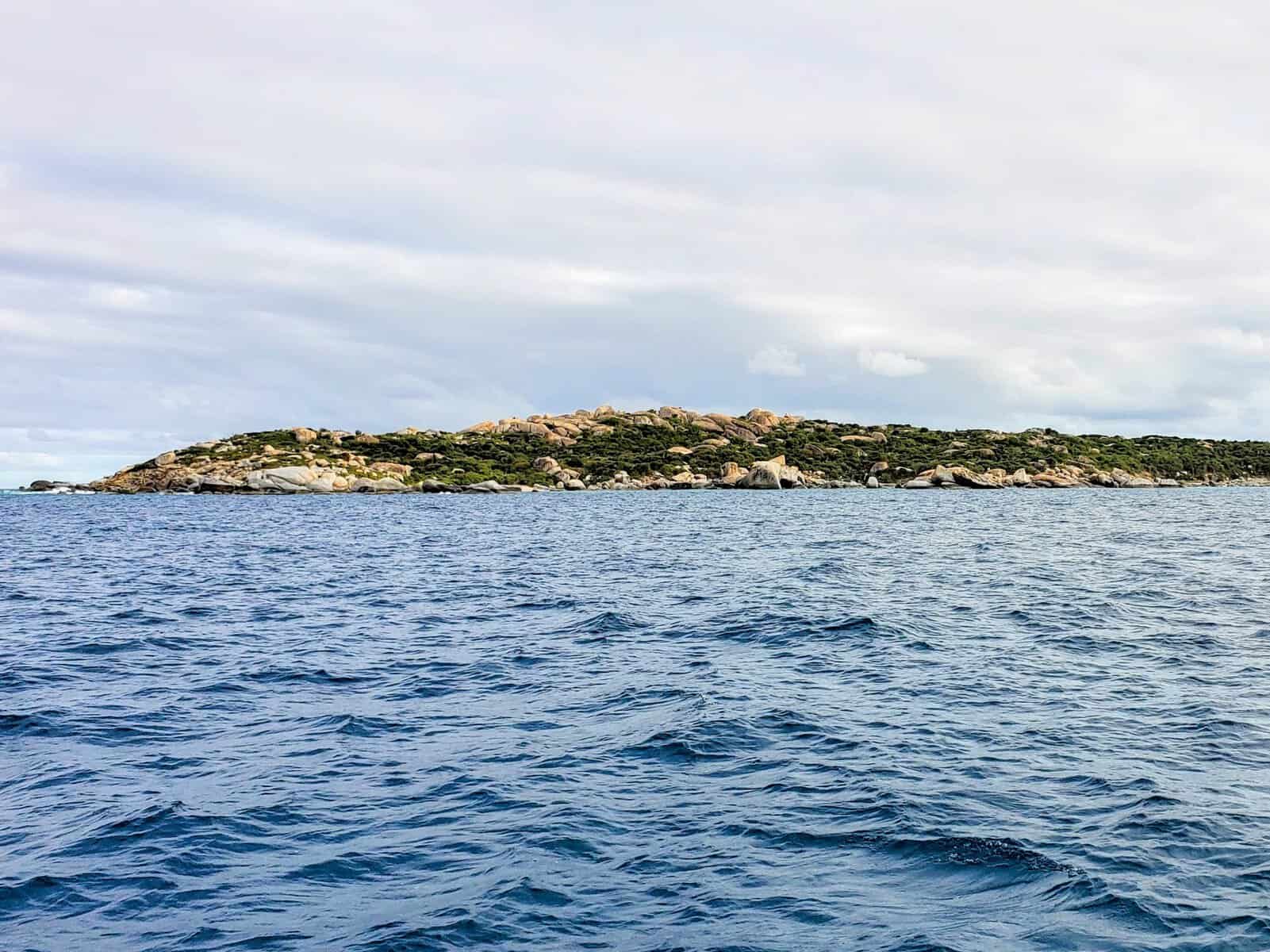
Spring Bay is another beautiful beach with boulders that are part of The Baths geological features but inaccessible from The Baths National Park. It has its own parking lot and entry trail. There are no amenities, and it’s free to visit.
Valley Trunk sits just north of The Baths. It’s part of a private community so only accessible by boat, but it’s a wonderful spot to anchor and swim in. You’ll find other yachts anchored there, a white sandy beach, and some decent snorkel pockets on the north and south ends of the bay.
How Much Time to Plan at The Baths
For most visitors, two hours is usually enough to trek through The Baths. If your schedule allows for more time, it’s an incredible place to spend a full day. You can walk down, spend the afternoon at the beach, grab a snack, head back up, and finish the day poolside at the Top of the Baths.
For slow travelers and anyone who just loves lounging on a beautiful beach, this is a spot where you really can waste the day away.
Where to Stay on Virgin Gorda / Charter Yachts in the British Virgin Islands
Virgin Gorda is known for its high end resorts and stunning rental properties if you’re looking for a land based stay.
Rosewood Little Dix Bay
A Virgin Gorda classic, Rosewood Little Dix Bay is a beautiful choice for a special occasion or travelers looking for a little extra luxury. 👉Click here to Check Dates👈
The other option is arriving by boat, which is an incredible way to experience The Baths. You can visit as a short stop in the mooring field, or come into the marina and treat The Baths as a day trip from there. Our Ultimate 7-Day BVI Sailing Itinerary shares how to incorporate The Baths into your sailing route.
For almost 25 years, The Baths National Park is still one of my favorite experiences in the British Virgin Islands! However you choose to visit, Virgin Gorda has a way of making you want to stay a little longer, whether you’re settling in at a resort or anchored just offshore.